In the Watson and Crick forum, PG and Research Department of Biotechnology, Sri Sankara Arts and Science College, M. Sharmila from 1st M.Sc. Biotechnology is going to give a presentation on “MENTAL HEALTH AND WELLNESS” on 20 September 2025 from 1:00 to 1:30 PM.
Total Pageviews
Saturday, September 20, 2025
The Watson and Crick forum
In the Watson and Crick forum, PG and Research Department of Biotechnology, Sri Sankara Arts and Science College, B. Praveena from 1st M.Sc. Biotechnology is going to give a presentation on “Airborne diseases” on 20 September 2025 from 1:00 to 1:30 PM.
.
Friday, September 19, 2025
Industrial visit to the Central Sericultural Germplasm Resources Centre (CSGRC), Hosur on 18th September 2025
Central Sericultural Germplasm Resources Centre (CSGRC), Hosur
Date
of Visit: 18th September 2025
As part of the academic curriculum and to enhance the practical knowledge of students, the Department of Biotechnology, Sri Sankara Arts and Science College, Kanchipuram, organised an industrial visit to the Central Sericultural Germplasm Resources Centre (CSGRC), located in Hosur, on 18th September 2025. A total of 58 students, accompanied by faculty members Dr Harishkumar R, Assistant Professor and Dr Vinodhini S, Assistant Professor, Department of Biotechnology, took part in this educational visit.
The
visit aimed to provide students with exposure to real-world applications of
biotechnology in the field of sericulture, including silkworm rearing,
silk production, genetic resource conservation, and the scientific research
behind the industry.
Objectives of the Visit
- To
understand the silkworm life cycle and rearing practices.
- To
study mulberry cultivation and its role in sericulture.
- To
learn about different silk species and their production processes.
- To
observe the conservation techniques of silkworm genetic resources.
- To
explore potential internship and research opportunities at CSGRC.
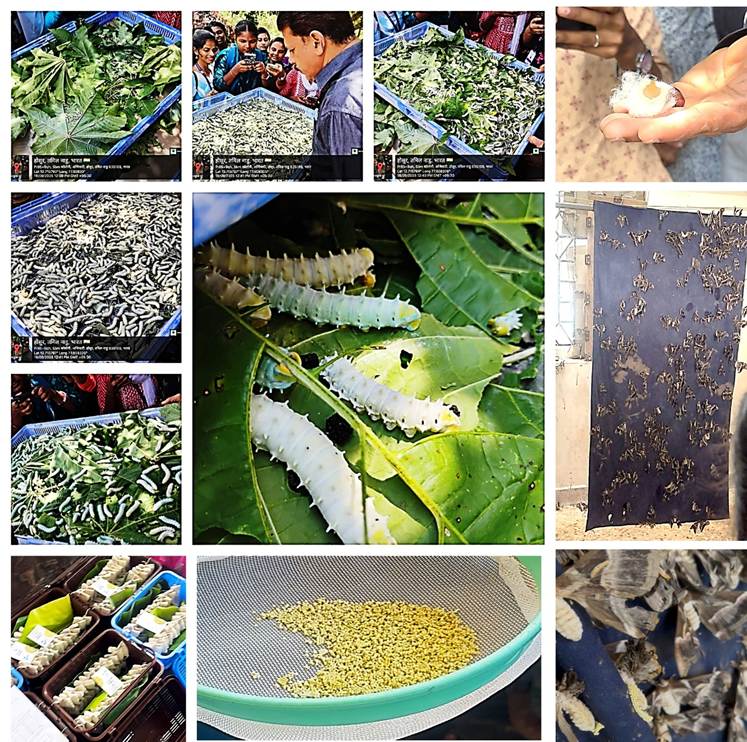
The lifecycle of the silkworm (Eri
variant)
About the Organisation: CSGRC, Hosur
The
Central Sericultural Germplasm Resources Centre (CSGRC) is a premier
institute under the Central Silk Board, Ministry of Textiles, Government of
India. It serves as a national repository for silkworm genetic resources
and plays a vital role in collection, conservation, characterisation, and
utilization of diverse silkworm and mulberry germplasm for research and
development in sericulture.
Summary
of the Visit
Upon arrival, the students and faculty were warmly received by the Dr. V. Nishitha Naik [Director of CSGRC, Hosur]. A group photo session was conducted with the Director and scientists of the institute, the faculty, students, and the scientists.
We
sincerely thank Dr Hridya H [Scientist C] for her excellent coordination
and support in arranging the visit and handling the approval processes. The
visit included presentations and hands-on exposure to the following key areas:
Technical
Sessions by Scientists
- Dr
Nandhan [Scientist B]
delivered an informative session on:
- Mulberry
cultivation and improvement techniques
- Silkworm
rearing and management practices
- Silk
production process, from cocoon to yarn
- Dr
Muthulakshmi M [Scientist D]
explained:
- The
various silk species, such as Mulberry, Eri, Tasar, and Muga at
Seri Museum.
- The
biological characteristics and production cycle of each species
- Silk
extraction techniques and post-rearing processes
- Shri
Raju Mondal [Scientist
C] presented:
- The
role and functions of CSGRC in sericulture-genetic conservation
- Ongoing
research and collaborative projects
- The
importance of conserving indigenous and exotic silkworm varieties
- Covered
the biotechnological aspects of sericulture and mulberry gene
conservation.
Detailed
understanding of multivoltine and bivoltine silkworm breeds, Familiarity
with the life cycle of the Eri silkworm species, Practical exposure to
the silk rearing and cocoon production process, Knowledge of sericulture
genetic resource management and conservation techniques, and Awareness of
how biotechnology supports the silk industry in India.
Finally,
students were able to learn about the composting of silkworm wastes, explained
by Dr Sakthivel [Scientist D] and Dr Nandhan [Scientist B].
Internship
Opportunities
During
the visit, the students were informed about internship opportunities at
CSGRC. The institute encourages student involvement in research, providing
exposure to lab practices, data collection, and hands-on work with silkworm
species and mulberry varieties.
They had
the great chance to visit their museum, which had all of their models and
showed the life cycles of the silkworm. And explained the history and evolution
of silkworm production and shared the scope of sericulture in the field of
biotechnology and entrepreneurship in the silkworm field. We got to know how
many varieties of plants are used for feeding the silk worm, especially the
mulberry plant, including how they are conserved in their laboratory.
Dr
Prateesh Kumar PM [Scientist D] explained to us every stage of the silkworm
from egg to adult at Eri Silkworm Seed Production Centre, Hosur.
Scientists
explained to us how they reproduce, and how to do gender identification while
allowing reproduction with a simulated environment in favour of fertilisation.
The
students can actively interact with scientists and clarify their
doubts, including the scientific and industrial scope of sericulture.
Conclusion
The
industrial visit to CSGRC, Hosur, was an enlightening and educational
experience for the students of the Department of Biotechnology. It provided a
valuable platform for integrating theoretical knowledge with real-world
applications in sericulture and biotechnology. The sessions conducted by the
scientists were highly informative and helped students gain insight into
advanced scientific processes in the silk industry.
The
Department extends its heartfelt thanks to the Director and Scientists of
CSGRC, and special appreciation to Dr Hridya H [Scientist C] for
making the visit a success.
DEVELOPMENT OF CHICK EMBRYO
The chick embryo is a classical
model for studying vertebrate development and cell biology. The blastoderm, a
disc-shaped layer of cells on top of the yolk, undergoes rapid proliferation
and differentiation during early embryogenesis. Stem cells within the
blastoderm play a crucial role in establishing the embryonic germ layers. To
visualize these structures, histological staining and mounting techniques are
employed. Eosin stains the cytoplasm and extracellular components pink to red,
providing clear contrast. This practical was carried out by I M.Sc.Biotechnology students
(Molecular Cell Biology major paper) to study the development of chick embryo and morphology of 72 hrs chick
blastoderm using mounting and staining techniques.
ISOLATION OF DNA FROM HUMAN BLOOD SAMPLE
As a part of the Molecular Genetics practical I M.Sc., Biotechnology students isolated DNA from their own blood sample. First lane (starting from left hand side) loaded with 100bp ladder DNA, lane 3, 5 and 7 DNA was extracted from 1 ml of whole blood using TKM buffer, Triton X-100, 10% SDS and 6M NaCl. It is a rapid method (within an hour) and high yield of DNA from less quantity of blood (can be applied to extract DNA from as little as 10 microlitre of blood). The blood sample was volenteerly donated by the M.Sc. student, namely, Mr. M. Sampreeth. The protocol was adapted from Lahiri and Schnabel, 1993.
Tuesday, September 16, 2025
Proud Moments for Our College and Our Department: Achievements in Cricket
Happy
to share the outstanding accomplishments of our Ist BSc students YOGESHWARI
D and HAVANTHIKA S, who have brought great pride to our college through
their exceptional performance in cricket.
ABINAYA
M, HAVANTHIKA S, YOGESHWARI D,
and SIVA DHARSHINI S were selected to represent our institution in the
prestigious University Cricket Tournament. Their dedication, skill, and
sportsmanship were evident throughout the competition, earning them
well-deserved recognition at the university level.
Adding
to this proud moment, our college recently hosted the Chief Minister Trophy,
a highly competitive tournament featuring top talent from various colleges. We
are delighted to announce that YOGESHWARI D and HAVANTHIKA S secured Second
Place, showcasing remarkable performance and determination on the field.
Her
achievement is a testament to her hard work; we congratulate both YOGESHWARI
D and HAVANTHIKA S on their inspiring journey and look forward to
many more milestones in their sporting careers.
Congratulations
once again! You make us proud.
The Watson and Crick forum, PG and Research Department of Biotechnology, Sri Sankara Arts and Science College, organised a student forum meet on 16/09/2025 from 1:00 to 1:30 PM.
K.
Yoganathan from 1st M.Sc. Biotechnology gave a
presentation on “Death Experience”. Department staff, Research Scholars
and Students participated in the meeting.
The welcome
address was given by Dr. B. Ramesh, HOD and Convenor
______K.
Yoganathan______ gave a detailed presentation on the Death Experience.
Students participated in the meet and during the questionnaire session.
The forum
meeting was over by 1:30 PM, with the vote of thanks delivered by Dr. P. Saravanan,
coordinator of the Watson and Crick forum.
Saturday, September 13, 2025
The Watson and Crick forum presentation on “Enzyme-linked sorbent assay [ELISA]”
The Watson and Crick forum, PG and Research Department of Biotechnology, Sri Sankara Arts and Science College, organised a student forum meet on 13/09/2025 from 1:00 to 1:30 PM.
V. Dhinesh
Kumar from 1st M.Sc. Biotechnology gave a
presentation on “Enzyme-linked sorbent assay [ELISA]”. Department staff,
Research Scholars and Students participated in the meeting.
The welcome
address was given by Dr. B. Ramesh, HOD and Convenor
______V.
Dhinesh Kumar______ gave a detailed presentation on Enzyme-linked sorbent
assay [ELISA]. Students participated in the meet and during the
questionnaire session.
The forum meeting
was over by 1:30 PM, with the vote of thanks delivered by Dr. Swarnkumar, coordinator of the Watson and Crick forum.
Description: ELISA (Enzyme-Linked Immunosorbent Assay) is a plate-based laboratory technique used to detect and quantify biomolecules such as proteins, antigens, or antibodies in biological samples by using highly specific antibody-antigen interactions combined with an enzyme-mediated colour change for signal detection.
The Watson and Crick forum presentation on “Azolla cultivation ”
The Watson and Crick forum, PG and Research Department of Biotechnology, Sri Sankara Arts and Science College, organised a student forum meet on 13/09/2025 from 1:00 to 1:30 PM.
E. Gopalakrishnan
from 1st M.Sc. Biotechnology gave a presentation on “Azolla
cultivation ”. Department staff, Research Scholars and Students
participated in the meeting.
The welcome
address was given by Dr. B. Ramesh, HOD and Convenor
______E.
Gopalakrishnan ______ gave a detailed presentation on Azolla cultivation. Students participated in the meet
and during the questionnaire session.
The forum meeting
was over by 1:30 PM, with the vote of thanks delivered by Dr. Harishkumar
Rajendran, coordinator of the Watson and Crick forum.
Description: Azolla
cultivation involves growing the floating water fern, typically in shallow,
shaded ponds lined with plastic, that contains a symbiotic blue-green algae
responsible for atmospheric nitrogen fixation. For successful growth, azolla
needs 5-10 cm of water at a temperature of 20-35°C, a water pH between 5-7, and
an adequate supply of phosphorus.


